
Thursday, March 24, 2011
The Leadership and Technology Gap
Recently, David Warlick sat down with Scott Klosoksy to talk about the gap between leadership capacity and technology understanding, which is somewhat of a growing epidemic within the ranks of CEOs, administrators, and leaders across all disciplines. The graphic below is a visualization of the conversation, encapsulating the most salient points of the issue. After looking through the graphic, what strikes you as the most significant new concept that you learned? What are you going to try or do differently after analyzing this graphic? What information on the graphic changes your mind about how you view the relationship between technology and leadership? How can we as educational leaders close the "Gap" between leadership and digital aptitude?

Sunday, March 20, 2011
Creating Personal Learning Networks For District Administrators
The development of a personal learning network can be one of the most catalytic projects a school administrator can engage in. Book groups are great. Conferences are highly instructive. But both are intermittent and somewhat interruptive. A digitally-driven personal learning network, however, is ongoing and integrated into your professional (and personal) life. When a network of professionals all simultaneously learns and circulates information, the network has an energizing effect, serving to solve problems and expand knowledge-bases.
Last week, while teaching a class to district administrators about the use of digital-age tools, I explained the power of a personal learning network. One of the goals of the course is for district administrators to develop a personal learning network and to participate in a digitally-oriented professional learning community. What follows is a guide (of sorts) for district administrators who would like to develop their own personal learning networks. The guide is organized by some of the questions that district administrators asked me when I was teaching the class on digital tools.
What are Personal Learning Networks?
Here, William Richardson gives a brief overview of a PLN.
This infographic illustrates the degree to which people participate in PLNs varies.

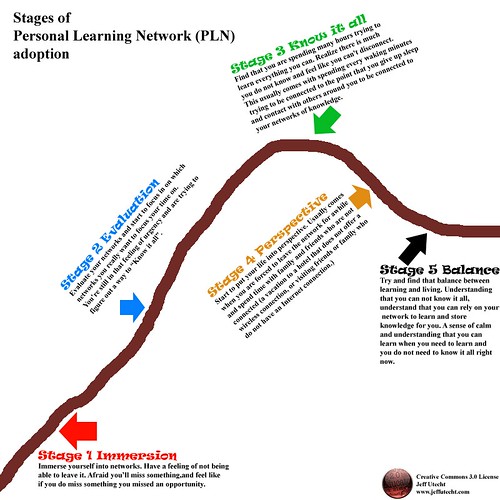
Here, Jeff Utecht reviews the stages a person experiences as he/she engages in a PLN.
How Do I Develop One?A great slideshow covering the tools people use to engage in a PLN. Build a PLN with Web 2.0 Tools (FETC 09)
View more presentations from Katie Morrow
How can PLNs help my PLC?
Mark Wagner does a great job in this slideshow explaining how PLNs and PLCs are interwoven.
Where do I go for resources?
Thursday, March 3, 2011
Let me introduce you to George Couros
George Couros is a principal in Alberta, Canada. He blogs here.
Wednesday, March 2, 2011
School Safety, Social Media, and Administrative Technology Aptitude
This infographic begins with an intriguing question:

As I've said before, questions almost always lead to more questions (for me for that matter), so I began to think deeper about how this infographic interfaces with schools.
- "In an area-wide emergency, how likely would you be to use social media channels to let your friends and family know you are safe?
As I've said before, questions almost always lead to more questions (for me for that matter), so I began to think deeper about how this infographic interfaces with schools.
- In the event of an emergency, how likely are parents to use social media channels to acquire necessary information?
- How could school communication through social media help or hinder effective management and facilitation of a crisis plan during a time of crisis?
- Do administrators understand digital-age tools well enough to effectively utilize them to communicate?
- Do school administrators understand digital-age tools well enough to even give the tools a chance as a potential means of communication?
Monday, February 21, 2011
Educating School Boards about Social Media
Progressive school leaders across the nation are trying to help school boards (and other educational-community stakeholders) to better understand digital-age tools so that educators can formally use them to amplify learning. Currently, most school districts are taking a "ready, FIRE, aim" approach to any social media that they are allowing beyond the school doors, meaning that they are permitting the use of the digital tools without meaningfully amending and shaping policy to ensure reasonable safety, sensible boundaries of application, and appropriate response to infractions in expectations.
Karl Fisch and Dan Maas (of Littleton Public Schools), however, have taken an awesome approach of educating the school board so that they can better structure policy, procedures, and practice that align with their district's vision and purpose and so that their policies are unique in meeting the needs of the communities that the board represents. The "prezi" below is not only functional in educating school boards on social media (and others for that matter), but it also has an effective slant and tone for the novice or inexperienced (who sometimes get overwhelmed or cynical).
How should we engage and educate school boards about digital-age tools? What other educational-community stakeholders need a primer social media? How else can we not only demystify but also reveal the potential of digital-age tools? Does anyone else have a resource for or an example of educating school boards about social media?
Sunday, February 20, 2011
Mission: Engage, Then Empower . . . Superintendents!

I admit that I'm not a huge fan of the reports or mandates that come out of the Dept. of Ed., but I've been spending more time giving the national tech plan a closer look, perhaps hoping to find something that I can relate to. I have to reluctantly admit that I'm captivated by it.
It's easy to navigate, it has some depth and thoughtfulness, and Karen Cator has edtech credibility and educational authority. I know there is some criticism, but as I drill down into the document, I am less wary of it.
Take this graphic for example, which outlines a student-centered environment enhanced by digital-age tools. I love it. It's blended, is multi-layered, and accounts for the "alternating current" of learning and teaching that should ideally characterize an environment of powerful learning and teaching. To fully understand this graphic, however, requires some background knowledge of edtech. Almost all of my colleagues would struggle with understanding the features that typify a personal learning network, or understanding how twitter hashtags and social bookmarking define the ways that peers digitally connect around common interests, or understanding how social networking augments our opportunities to access expertise and authoritative sources.
I've said before that superintendents need to "get it" before we can "lead it," and I'll take this opportunity to say it again. To achieve the goals embedded in this graphic, superintendents need systematic edtech programming to support their development in using and understanding the tools so that they can better understand the urgency of the initiative and better lead the reform.
Whether it's centralized education service agencies, state departments of education, curriculum-ed. leadership-education associations, or the federal Dept. of Ed., a movement needs to begin. The standards are written (the what), and the format has been expertly set in motion (the how). Let's engage, and then let's empower.
Friday, February 18, 2011
Case In Point
Don't understand problem-based learning? Don't understand how technology can amplify learning? Don't understand how technology can turn a teacher-centered classroom into a learner-centered classroom? Don't understand a digitally-oriented professional learning community? Watch this.
ADE Application Video — Dan Meyer from Dan Meyer on Vimeo.
Post script thoughts: How is the State of Wisconsin going to ever attract a teacher like Dan to teach in our schools with what is currently happening? Thoughts?
Subscribe to:
Posts (Atom)