Here are my notes:
Thursday, April 26, 2012

Thursday, April 12, 2012
The Autonomous Discovery of Google Kids
In his recently published book, From Digital Natives to Digital Wisdom, Marc Prensky wrote, "It is critical, though, to understand that because the locus of “knowledge” has, in the 21st century, moved to a great extent from the teacher to the Internet, and because the personal passions of our 21st century students have become the kids’ best (and often their only) motivation to learn, our teachers’ job—in fact their very raison’d’être—is going through enormous change." I recently saw this play out first-hand in my nine-year-old son.
It started with this:

And then this (which is a tutorial produced by another elementary school kid far from Wisconsin):

And before I knew it, he was proudly standing over this:

Aside from being a great example of how different types of media work harmoniously, it also illustrates a couple of stronger points: Google kids autonomously learn. They know that they have immediate access to resources that can amplify and extend their learning. They are more independent and self-paced as they learn.
Here, my son was not coerced, lectured, drilled, or measured. We was excited and interest-driven, while utilizing global resources to complete a hands-on, technology amplified project-all without a single word of encouragement or persuasion from an adult. He's a Google kid.
Post blog reflection:
How can we capture this? How can kids thrive in a different environment? How can we translate the attributes of this scenario into powerful student understanding of complex concepts? How can we embrace, funnel, and leverage self-guided discovery in a technology-amplified classroom?
It started with this:
And then this (which is a tutorial produced by another elementary school kid far from Wisconsin):

And before I knew it, he was proudly standing over this:

Aside from being a great example of how different types of media work harmoniously, it also illustrates a couple of stronger points: Google kids autonomously learn. They know that they have immediate access to resources that can amplify and extend their learning. They are more independent and self-paced as they learn.
Here, my son was not coerced, lectured, drilled, or measured. We was excited and interest-driven, while utilizing global resources to complete a hands-on, technology amplified project-all without a single word of encouragement or persuasion from an adult. He's a Google kid.
Post blog reflection:
How can we capture this? How can kids thrive in a different environment? How can we translate the attributes of this scenario into powerful student understanding of complex concepts? How can we embrace, funnel, and leverage self-guided discovery in a technology-amplified classroom?
Monday, April 2, 2012
For Goodness' Sake
When is the last time you've knelt-down to tie the shoe of a 5-year-old? When is the last time you cared enough to remember someone's birthday? Do you have the presence of mind to listen instead of making excuses when someone is expressing concern? Can you set aside your own needs and wants in seeking the greatest good for someone or something else? Can you extend yourself for others purely because it's the right thing to do and without the expectation of personal benefit?
Are we willing to trade in our problems for our possibilities? Are we willing to lift what is low, to unite what lies apart, to advance what is left behind? Is it time to have a conversation that we have not had before?
Friday, March 30, 2012
Thursday, March 22, 2012
@McLeod, Circa 2006
In Scott McLeod's inaugural blog post of Dangerously Irrelevant, he said, "This blog is intended to highlight and help with the leadership issues related to K-12 technology. We can (and do) pour ungodly sums of money into teacher training, student programs, and infrastructure – these are all good. However, we will see few tangible, sustainable benefits in most places until they have leaders who know how to effectively implement, build upon, and sustain those initiatives. We need more effective technology leaders. We need them in formal leadership positions like principal and superintendent rather than informal, often powerless positions like media specialist or technology coordinator. We need them now."
Indeed, we are still talking about the need for leadership, and we still need significantly better leadership from principals and superintendents when it comes to the meaningful integration of technology into education. Looking at this through the lens of an archeological dig (of sorts), the very content of McLeod's blog points to how we've changed our approach to #edtech reform.
Here's a Wordle of McLeod's blog posts in August and September, 2006.

We can see that the word "school" has significant standing along with "technology," "schools," and then "students." The words "leadership, administrators, teachers, district, leaders, and student" also have ancillary prominence.
Here's a Wordle of McLeod's blog posts in October, November, December of 2011 and January, 2012.

Immediately, we see that the word "student" holds the biggest prominence in the wordle, followed by "technology," "learning," and "need." The word "School" holds a subordinate place in the wordle. If I squint my eyes, I can see "leadership" and "teachers," but I don't see "district," "administrators," or "leaders" at all. I think this represents a change of focus, a change in McLeod's internal dialogue. McLeod's own "shift" in focus (from writing about school reform to writing about student-centered learning) is exactly the shift that we must all make.
At Dangerously Irrelevant's inception, it was a blog focused on "formal" leadership issues involving meaningful technology integration. What it may have evolved into is a more eclectic, wide-ranging blog that focuses on student learning. The realization here is one of purpose. The intent of administrative #edtech development is to instill a deeper appreciation for and to cultivate a powerful inclination to leverage digital tools for student-centered learning. That is, the moment we all shift our focus--just as McLeod has over time--from focusing on administrative #edtech development to student-centered educational reform; that is, the the moment we shift our focus from #edtech reform in schools to leveraging #edtech for student-centered learning, then we are closer to the antithesis of administrative irrelevance.
Friday, March 16, 2012
The New Transformational Trend: People
The following graphic prompts us to peek into the future. Certainly, we all look to technology as a primary driver of change, yet the trends below are about people and not technology. This is not to say that we can't look at how the trends below work in, with and around social media networks, but what is easy to discern is that people of varying agency and ideology are driving these transformative trends, not digital tools alone. Indeed, the focus on "People" is a trend for transformation.
So, let's cross-walk this concept (of the importance of people over technology alone) over to education and look at the digital tools being proposed as solutions to our "crisis." Teachers still scaffold remediation after classrooms have been "flipped"; teachers still accommodate, manage, and leverage iBooks after New iPads have been integrated; and teachers still formatively assess, elicit growth, provide support, and respond to varying learning styles after mobile phones have been successfully accepted into schools.
So, how does this realization change our conversations? How does this realization (of the both constraining and enabling influence of people on digital tools) change how we look for solutions? Are are concepts such as the "flipped classroom" fads that distract us from the real work, which is to develop people?
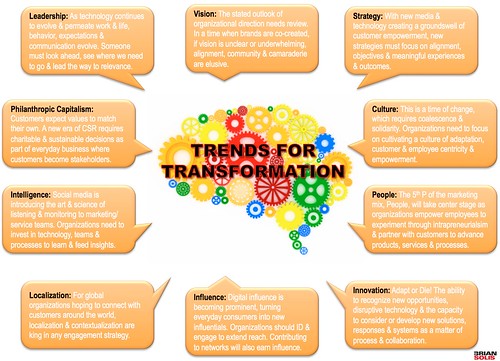 |
| Created by Brian Solis Flickr: b_d_solis |
So, let's cross-walk this concept (of the importance of people over technology alone) over to education and look at the digital tools being proposed as solutions to our "crisis." Teachers still scaffold remediation after classrooms have been "flipped"; teachers still accommodate, manage, and leverage iBooks after New iPads have been integrated; and teachers still formatively assess, elicit growth, provide support, and respond to varying learning styles after mobile phones have been successfully accepted into schools.
So, how does this realization change our conversations? How does this realization (of the both constraining and enabling influence of people on digital tools) change how we look for solutions? Are are concepts such as the "flipped classroom" fads that distract us from the real work, which is to develop people?
Friday, March 9, 2012
The Superintendency: It's a Calling
It all started with this. It's a great post with thoughtful considerations on becoming a building principal. My comment, however, was to also think about the superintendency:
"Yes, building administrators are retiring every day, but so are superintendents. Indeed, we need courageous building principals to take on the challenge of district leadership too!"
This prompted Curt Rees (@wiscprincipal) to charge me with the following homework:

Accordingly, here is my sponsorship and advertisement, encouraging building-level principals to consider becoming superintendents.

Subscribe to:
Posts (Atom)